Tinmel Mosque & Atlas


Tour Overview
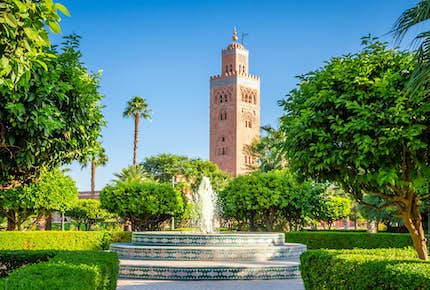
Tin Mel Mosque is a mosque located in the High Atlas mountains of North Africa. It was built in 1156 to commemorate the founder of the Almohad dynasty, Mohamed Ibn Tumart. It is one of the two mosques in Morocco open to non-Muslims, the other being the Hassan II Mosque in Casablanca. Hitting the R203 road which leads to Taroudant through the Asni and Ouirgane way; we arrive at Tinmel, home to the Almohade Dynasty where we can still see pieces of the Medieval fortress, the royal necropolis shelters, the remains of the founder Abdel Moumen and the spiritual master Ibn Toumert. The mosque has been recently refurbished, and it is a model of the Almohade art. On the way back, we stop to Ouirgane, considered a gastronomic place where we have lunch. Afterwards, we continue our journey back to Marrakech
What's included
Itinerary
The building has a fortress-like exterior appearance with thick plain walls, which was characteristic of other Almohad mosques and buildings as wel. It has a roughly quadrangular floor plan, measuring 43 by 40 metres.A more unusual feature was the position and form of the minaret, located at the middle of its southern wall on top of the mihrab; a design feature which is not found in other historic mosques.The minaret has a rectangular base and projects outwards from the surrounding outer wall, but has a truncated or unfinished appearance, contrasting with the bold and monumental minarets of other Almohad mosques that came after (such the minaret of the Kutubiyya in Marrakech or the Giralda in Seville). The mosque has seven entrances: three on both its east and west sides and one central entrance to the north.
Inside, the mosque has a typical hypostyle layout with an interior courtyard. The main prayer hall is divided into nine “naves” (running roughly north to south) by rows of pointed horseshoe arches. Another aisle, perpendicular to these rows of arches (running roughly east to west), runs along the southern wall (the qibla wall towards which worshippers prayed). The mosque is a notable example of the “T-plan” or “T-type” mosque which is found in earlier Almoravid architecture and was standard for later medieval Moroccan mosques: the aisle running parallel to the qibla wall and the middle nave leading to the mihrab, running perpendicular to that wall, are wider and more prominent than the other aisles of the mosque and thus draw a “T” shape in the floor plan of the building. The southern aisle of the qibla wall also features three muqarnas (“honeycomb” or “stalactite”) cupolas: one at the middle, in front of the mihrab, and one at either end, at the southern corners of the mosque. Each cupola is also flanked by “lambrequin” or “muqarnas” arches below, whose intrados are enhanced with carved sebka, muqarnas, and palmette/seashell motifs. Multifoil arches also run along the northern edge of this aisle, further setting it apart from the rest of the mosque. All these decorative flourishes also served to emphasize the southern aisle and middle nave in the T-plan of the mosque. The rectangular courtyard (sahn) of the mosque occupies a large part of its northern section, corresponding to the width of the mosque's five middle naves and the length of three aisles of arches. It is surrounded on all sides by the arches of the prayer hall and its extensions.
The mihrab (niche symbolizing the qibla), situated in the middle of the southern wall, is very similar in form and decoration to that of the Kutubiyya Mosque and other Almohad mosques, consisting of an octagonal alcove covered by a small muqarnas cupola. The wall surrounding the mihrab's opening is decorated with carved geometric and interlacing motifs. Unlike the Kutubiyya Mosque, the decorative capitals of the engaged columns around the mihrab are carved from stucco rather than marble. On either side of the mihrab are two tall arched openings: one led to a small chamber where the minbar (pulpit) was stored, while the other led to the imam's entrance at the eastern base of the minaret.
- Reach out to us with your preferred travel dates and group size via the form on this page.
- We'll get back to you within 24 hours with a personalized itinerary and quote based on your preferences.
- Once you're happy with the itinerary, we'll send you a secure payment link to confirm your booking.
- After payment, you'll receive a confirmation email with all the trip details and your local guide's contact information.
- the remaining balance can be be paid directly to the guide on the day of the trip, in cash or via another secure link.
- Enjoy your unforgettable day trip in Morocco!
FAQs
Most private day trips start between 8:00 and 9:00 AM from your accommodation and return in the late afternoon or early evening (around 6:00–8:00 PM), depending on the destination and pace.
Pickup and drop-off are included from your hotel, riad, or any accessible location. If your accommodation is inside the medina, your driver will meet you at the nearest vehicle-accessible point.
All our day trips are fully private. You will travel only with your own group and a dedicated driver or guide, ensuring flexibility, comfort, and a personalized experience.
Yes. Private day trips are flexible and can be adjusted to your interests, pace, and preferences. Scenic stops, photo opportunities, or short detours can usually be arranged with your driver.
Driving times vary by destination. Coastal trips like Essaouira take about 2.5–3 hours each way, while mountain destinations such as the Atlas Valleys or Ouzoud Waterfalls may take 2–3 hours. Your driver will include scenic stops to make the journey comfortable.
Transportation is provided in modern, air-conditioned vehicles suited to your group size, with comfortable seating and professional drivers experienced in long-distance travel.
Certified city guides are included in City sightseeing tours, most other, while others offer optional local guides for deeper cultural insight. Your driver can help arrange a local guide if desired.
Meals are typically not included, allowing you to choose restaurants according to your taste and budget. Your driver/guide can recommend quality local restaurants along the route.
Yes. Private day trips are comfortable and can be adapted for families, children, or travelers who prefer a relaxed pace with minimal walking.
Comfortable clothing, walking shoes, sun protection, a hat or scarf are recommended. Depending on the destination and season, a light jacket or swimwear may also be useful.
Tickets
Your info
Any special plans? (Optional)